
News & insights
Energy Efficiency Starts with System Design
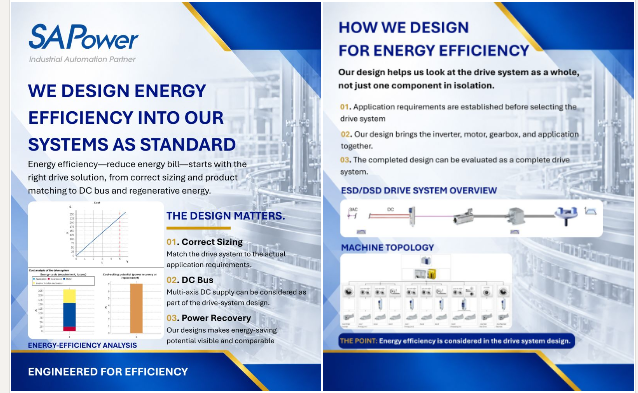
Why the Most Efficient Systems Are Designed That Way from the Beginning
Energy efficiency has become a priority for manufacturers looking to improve productivity, reduce operating costs, and maximize the performance of their automation investments.
However, many organisations still view efficiency as something that is achieved by selecting a more efficient motor, drive, or component.
Modern engineering takes a broader view.
The most efficient industrial systems are rarely the result of a single product choice. They are the result of a well-engineered design that considers how the entire drive system will perform as a whole.
In other words, energy efficiency starts long before a machine is switched on.
Looking Beyond Individual Components
Industrial drive systems consist of multiple technologies working together, including motors, drives, gearboxes, mechanical systems, and the application itself.
When these elements are considered individually, opportunities for improvement can be missed.
Leading manufacturers are increasingly moving away from component-focused thinking and adopting a system-level approach. This involves understanding how each element contributes to overall performance and identifying opportunities to improve efficiency across the complete solution.
The objective is not simply to install efficient products.
The objective is to create an efficient system.
The Importance of Correct Sizing and Product Matching
One of the most important stages in designing an efficient drive system is selecting technologies that are correctly matched to the application.
A solution that is oversized, undersized, or poorly matched can affect efficiency, performance, reliability, and long-term operating costs.
This is why understanding the application remains a critical part of the design process.
Factors such as operating conditions, load characteristics, duty cycles, speed requirements, and production objectives all influence how the system should be engineered.
By aligning the technology with the actual requirements of the application, manufacturers can create solutions that deliver both performance and efficiency.
Efficiency Is Built into the System
Modern drive system design increasingly considers opportunities to improve energy utilisation throughout the application.
This may include evaluating approaches such as:
Correct motor and drive selection
Mechanical optimisation
Common DC Bus architectures
Regenerative energy opportunities
System-wide performance analysis
These strategies allow engineers to evaluate the complete energy flow within the system rather than focusing on a single component.
The result is a more informed approach to efficiency that supports both operational performance and long-term value.
Engineering Smarter Solutions
As energy costs, production demands, and sustainability objectives continue to evolve, manufacturers are placing greater emphasis on intelligent system design.
The organisations achieving the best results are often those that consider efficiency from the very beginning of the project rather than trying to improve it later.
At SA Power, we believe energy efficiency should be engineered into every solution. By considering the complete drive system, understanding the application, and selecting technologies that work together effectively, we help customers achieve solutions designed around performance, efficiency, and long-term operational success.
Because the most efficient systems are not created by chance.
They are designed that way.