
News & insights
Understanding Motion: Why Machine Performance Starts Before the Drive
Modern Machines Demand More Than Motion Components
Every automated machine is built around one fundamental objective: controlling motion.
Whether moving products along a conveyor, positioning materials with precision, synchronising multiple machine axes, or executing complex motion profiles, every process depends on motion being controlled accurately, consistently, and efficiently.
As manufacturing systems become more advanced, however, the challenge is no longer simply creating movement.
The challenge is understanding how that movement contributes to the overall performance of the machine.
This is where modern automation is evolving beyond component selection and towards application-focused engineering.
Motion Is the Foundation of Machine Performance
At the heart of most automated systems lies a combination of motion control strategies working together to achieve a specific outcome.
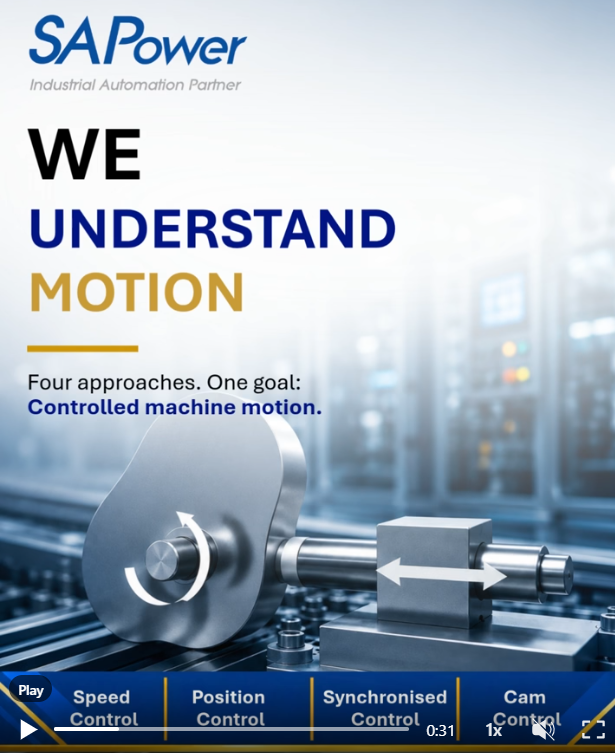
Speed control keeps processes running at the required rate. Position control ensures accuracy and repeatability. Synchronised control allows multiple axes to operate in precise coordination.
Cam control enables complex motion profiles that improve machine efficiency and throughput.
While each approach serves a different purpose, they all contribute to a common goal:
Controlled machine motion.
The most successful machine designs are not built around individual motion functions. They are built around understanding how those functions work together within the application.
Real Machines Require More Than One Motion Strategy
In practice, most industrial machines are far more complex than a single motor and controller.
A packaging machine may combine synchronised motion, position-controlled feeders, and cam-controlled processes. A converting line may require precise coordination between multiple axes while maintaining speed and product quality. Material handling systems often rely on a combination of motion strategies to achieve efficiency and reliability.
This means that motion control is rarely a product selection exercise.
It is an engineering challenge.
The objective is to understand the process and design a motion solution that delivers the required machine performance.
Moving Beyond Components
As automation technology continues to advance, manufacturers are increasingly looking for partners who understand the complete machine rather than individual products.
The focus is shifting from:
"Which drive should we use?"
to
"How should the machine move?"
This approach allows motion systems to be designed around production objectives, machine
dynamics, and operational requirements rather than technical specifications.
The result is greater performance, improved reliability, and solutions that are better aligned with the needs of the application.
Motion Knowledge Creates Better Outcomes
Successful machine automation depends on more than hardware.
It requires an understanding of torque, inertia, acceleration, positioning, synchronisation, and how these elements interact within real production environments.
When motion is understood at this level, automation moves beyond supplying components and becomes a process of engineering complete machine solutions.
At SA Power, we believe machine performance begins with understanding the application and the motion required to achieve it. By combining engineering expertise with motion control technologies, we help customers design solutions that deliver accurate, reliable, and efficient machine performance.
Because in modern automation, success is not determined by the drive alone.
It is determined by how well the motion is engineered.