News & insights
Why Versatile Braking Solutions Matter in Modern Industry
Meeting Changing Application Requirements with Confidence
No two industrial applications are exactly the same.
From material handling and packaging systems to conveyors, hoists, and automated machinery, different applications place different demands on machine components. What works effectively in one environment may not be suitable in another.
This is why manufacturers and machine builders are increasingly looking for solutions that can adapt to changing requirements without compromising reliability, performance, or safety.
In modern machine design, versatility is no longer a convenience. It has become a necessity.
The Growing Importance of Adaptability
Industrial equipment must often balance multiple requirements throughout its operating life.
Performance expectations evolve, production demands change, and equipment may be adapted for new applications over time.
As a result, engineers are increasingly favouring technologies that can be configured around the application rather than forcing the application to fit a fixed solution.
This approach helps create systems that are:
More flexible
Easier to standardise
Simpler to support
Better suited to a variety of operating conditions
More capable of supporting future requirements
The result is a more practical and sustainable approach to machine design.
Why Braking Solutions Need to Be Flexible
Braking systems play a critical role in industrial machinery, contributing to controlled stopping, holding functions, operational safety, and overall machine performance.
However, braking requirements can vary significantly depending on factors such as:
Load characteristics
Torque requirements
Environmental conditions
Duty cycles
Machine design
Selecting a braking solution therefore involves more than simply choosing a component that meets a specification.
Manufacturers need solutions that can be adapted to suit different applications while maintaining consistent performance and reliability.
One Platform, Multiple Possibilities
This is where modular braking technologies create value.
Rather than requiring completely different solutions for different applications, a modular platform provides the flexibility to configure the brake around specific operational requirements while maintaining the benefits of a proven design.
This helps manufacturers achieve a balance between standardisation and customisation, reducing unnecessary complexity while improving engineering flexibility.
It is an approach that supports both machine performance and long-term maintainability.
Proven Solutions Reduce Risk
Flexibility alone is not enough.
Manufacturers also need confidence that the technologies they select will perform reliably in real-world operating environments.
Proven solutions with established track records help reduce project risk, improve supportability, and provide greater confidence throughout the lifecycle of the machine.
This combination of reliability, adaptability, and practical performance is what makes certain technologies a preferred choice across multiple industries and applications.
Built for a Wide Range of Applications
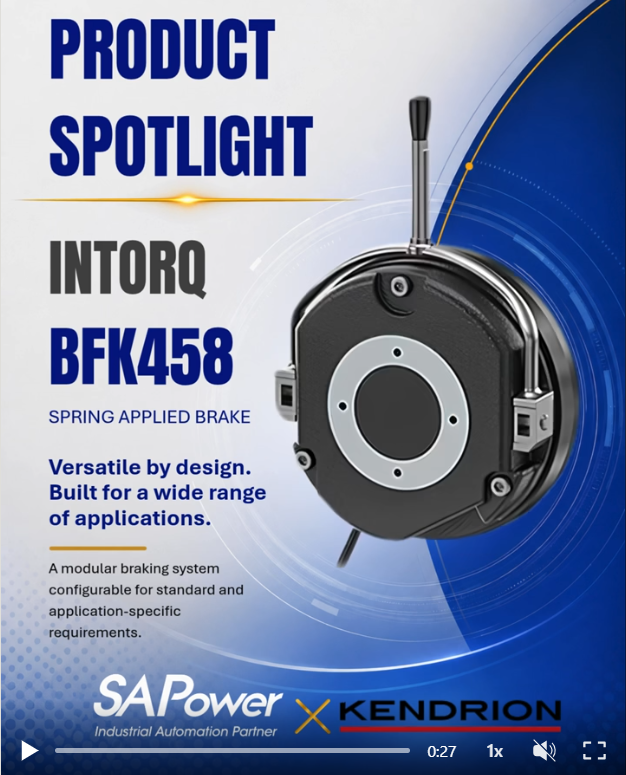
The Kendrion INTORQ BFK458 spring-applied brake reflects the growing demand for versatile industrial solutions.
With its modular design, broad configuration options, and suitability across a wide range of applications, it provides manufacturers and machine builders with a braking solution that can be tailored to specific operational requirements while benefiting from a proven and widely adopted platform.
At SA Power, we understand that selecting the right braking solution is about more than specifications. It is about understanding the application, identifying the operational requirements, and matching them with technology that delivers reliable long-term performance.
Because in modern manufacturing, the most valuable solutions are often the ones capable of adapting to the widest range of possibilities.